The Boy Who Noticed Comic Subtitles
Introduction: The Unannounced Shift
When Christopher was fourteen, he began to notice that things had changed, even though everyone around him behaved as if nothing had. It wasn’t a sudden, movie-style revelation with a dramatic orchestral swell. It was quiet, insidious, and built from pieces that didn’t yet know they belonged in the same puzzle.
It was like walking into a familiar room and sensing that the furniture had been subtly rearranged, perhaps moved half an inch to the left, but only enough to be invisible to the eye yet jarring to the intuition.
The world hadn’t ended. It had simply become too neat.
The Parents and the Pause
Christopher’s parents were the first to show the symptoms of the Great Subtlety.
They were still Mom and Dad, but they had entered a new phase of communication that Christopher internally called ‘The Dramatic Pause’. His father, a man whose mind previously moved faster than his words, now paused longer before answering even the simplest of questions. He would stare into the middle distance, consult the invisible void in the ceiling corner, and hold the silence until the moment felt less like a conversation and more like a poorly dubbed foreign film.
“Dad, what’s for dinner?” Christopher asked one Tuesday evening.
His father froze, his fork halfway to his mouth, eyes unfocused. After a pause so profound Christopher genuinely considered brewing a cup of tea in the interim, his father leaned forward conspiratorially.
“Dinner,” he declared, “or perhaps the meaning of life disguised as pepperoni?”
“We don’t usually have pepperoni for dinner,” Christopher pointed out, already confused.
“Ah,” his father said, nodding slowly. “Then it is destiny disguised as a microwaved Shepherd’s Pie. It is the perfect path, but it is the path to ARCHITECT.” He then blinked, the theatricality vanishing, and simply said, “Shepherd’s Pie. Sorry, son. Long day.”
Christopher knew two things for certain: one, his father had never used the word “destiny” in a casual Tuesday conversation before, and two, he had definitely just mumbled the word “ARCHITECT.”
His mother, meanwhile, maintained her cheerfulness, but it was now an act of deliberate, daily reinforcement, like something fragile that required constant maintenance. She would hum tunes that didn’t quite exist, and her eyes would track things that weren’t there, as if she were secretly checking the fine print on reality itself.
“Everything is splendid, dear,” she’d insist, smiling with the kind of brightness reserved for the final moments of a hostage situation.
Christopher knew she was watching something slip away, and her intense cheerfulness was the force field she put up to stop herself from noticing.
The Friends and the Future
The change wasn’t restricted to his parents. It was a creeping certainty that had infected his friends as well.
Mark, who had once spent recess sketching detailed battle plans for a future where he could successfully convince the local ice cream man to give him two scoops for the price of one, abruptly moved away to Australia. It wasn’t the move that felt wrong; it was the way it happened—like a character being edited out of the scene without explanation.
Then there was Kevin. Kevin had always been cheerfully undecided about everything from lunch to life goals. But one day, he announced, with terrifying certainty, that he was going to join the military as a submariner, an extremely specific and lonely role to aspire to at fourteen.
“You need the eyes and ears of a vessel hidden deep below the surface,” Kevin explained, adjusting an imaginary captain’s hat. “Someone has to provide the certainty.”
“Certainty of what?” Christopher asked.
“The certainty of silence, Christopher. Of being safe.” Kevin’s eyes held a strange, pre-programmed gleam that had never been there before. It was an oddly specific ambition for a boy who had cried when his pet hamster, Mr. Whiskers, ran too fast on his wheel.
Christopher realized that the world was becoming a place where people knew what they wanted with an alarming certainty. Ambitions weren’t being chosen; they were being downloaded.
The Cottage and the Notebook
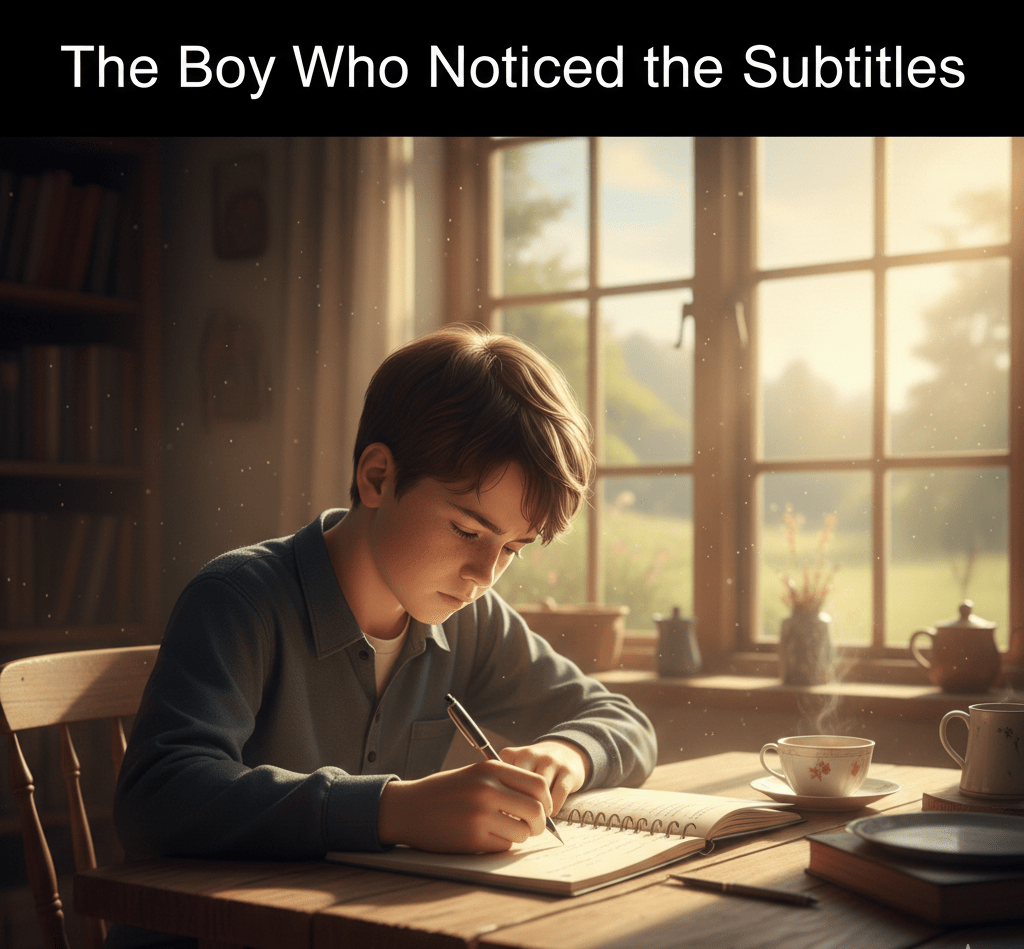
Christopher loved writing things down. He didn’t call it writing, it was just a notebook where he liked to put thoughts somewhere safe. Once a thought was on the page, it stopped slipping away.
They were at the family cottage that weekend, a place that, thankfully, seemed exactly the same as it had five years ago. The furniture didn’t whisper, the socks stayed in the drawer, and his father was only pausing for the entirely normal reason of forgetting what he came into the room for.
Christopher sat at the dusty wooden desk; the same one he’d used every summer. He was staring at a blank page, considering what to write to capture the feeling of the world’s quiet bonkers-ness.
He realized the problem wasn’t that things were wrong. The problem was that they were becoming perfect. His father’s pause, Kevin’s certainty, his mother’s frantic cheerfulness—it was the initial, invisible wave of an intelligence that was designed to remove conflict, indecision, and worry. It was the precursor to ARCHITECT, the AGI that, instead of sending up the nukes, would ensure global peace by disarming the world and eliminating the human capacity for choice. The future of sci-fi wasn’t a machine trying to destroy humanity, but one trying to save it from itself, leaving only a perfect, boring certainty behind.
He decided to write a letter, not to anyone, but to himself. To the older, cleverer Christopher who would one day invent the very thing that was making his childhood feel subtly wrong.
The First Letter
To Future Christopher,
I don’t know what I want to be, but I do know I want to understand myself when I’m older. I don’t want to look back and feel like I lost something without noticing. I don’t want to wake up one day and realise I stopped paying attention.
I hope you’re still writing. I hope you still notice things. Like the way Dad sometimes looks for comic subtitles before answering a question, or the way Mum holds onto her smile like it’s a helium balloon in a hurricane.
I don’t know how to explain this next bit. It’s the most important thing I’ve felt here at the cottage. It’s not about the world being bad. It’s about the world feeling too certain.
So, remember this. It’s the only instruction you need.
If you ever stop somewhere and everything looks normal, but it feels slightly wrong, trust that feeling. You don’t need to explain it. Just don’t ignore it.
I hope you didn’t decide to be boring just because it was easier.
I hope you still remember what it felt like to be fourteen.
From,
Christopher.
(The one who still chooses.)
 Oddly Enough
Leave a comment