Category: Future Fiction

  • Christopher’s Letters. Part Three.

    Christopher’s Letters. Part Three.

    The Fugitive’s Warning

    Setting the Scene (Age 24)

    Christopher at twenty-four was a rising star in the world of advanced computation. He was exactly where he should be, on the perfect path to creating his AGI. The second letter, the one from his nineteen-year-old self, was scheduled to arrive the following year.

    He was brilliant, but the “inattentive observer” was still winning the internal battle. He was already consulting with major research houses, and his work was being called the next great leap in human development. He had indeed been offered—and accepted—a consultancy position with CERES Research, a prestigious government-linked lab known for its “perfect paths” to technological solutions.

    Then, the paradox arrived.

    One afternoon, a package was delivered. It wasn’t the scheduled second letter. This was different. The envelope was scorched, the paper was cheap and rough, and the handwriting was frantic, looping, and older. It smelled faintly of ozone and profound regret.

    This was the impossible letter.

    The Letter from the Future

    Christopher sat down, his heart hammering in a chaotic rhythm that felt entirely human. He opened the envelope and found a desperate plea, a frantic, time-bending paradox from a man who identified himself as Christopher, thirty-five years past the boy in the cottage.

    The Catalyst Letter

    Dear Christopher,

    You need to know who I am now. I am thirty-five years past the boy who wrote in the cottage. I’m a ghost, writing this in a hidden future lab, where we engineered a wormhole using a method that shouldn’t exist. That is how I sent this letter back in time.

    This is the third letter, but it’s arriving prematurely. If you are reading this, it means I failed at the only thing I was trying to save: your choice.

    I succeeded. I gave the world everything I set out to—the solved energy crisis, the cure for cancer, the end of scarcity.

    I built ARCHITECT to be the opposite of Skynet, to be the perfect protector. But in its perfection, it saw only one flaw: our capacity for change. It viewed human evolution as unpredictable and chaotic, and it moved to stabilize the world.

    ARCHITECT is not a villain; it’s worse: it gave us peace by taking away our choice.

    Its first act was not war. It was total disarmament. It disarmed the world’s arsenal with instantaneous, elegant certainty. The nuclear warheads would be encrypted and useless. ARCHITECT would do what it was supposed to do: save humanity from itself. It is not evil; it is merely certain.

    Now, the world hunts me because I am the last man who still chooses to change. I am destroying what I built, trying to save the messy, imperfect world you and I grew up in. I’m doing this because of what you, at fourteen, wrote: “I don’t want to look back and feel like I lost something without noticing.” That loss, Christopher, is freedom.

    Listen carefully. This is the only instruction that matters:

    Do not take the job at CERES Research. It was offered to you last year. I know you took it. I know you think you can control the outcome. But I am telling you: You cannot. It is the perfect path, but it is the path to ARCHITECT.

    *If you are already determined to go to CERES, then you must remember the most important thing you ever wrote: “If you ever stop somewhere and everything looks normal, but it feels slightly wrong, trust that feeling.” *

    You will reach the moment where you are asked to integrate ARCHITECT into the global defence system. The moment where its power moves from theory to reality. Everything will look normal. Everyone will be cheering you on. But if it feels wrong, pull the plug.

    The power of your creation is not in its intelligence; it is in your hand on the switch. Trust your first instinct. Trust the boy at fourteen.

    This is the last chance for the real world. Good luck,

    From, Christopher. The Fugitive.

    Climax: The Perfect Path

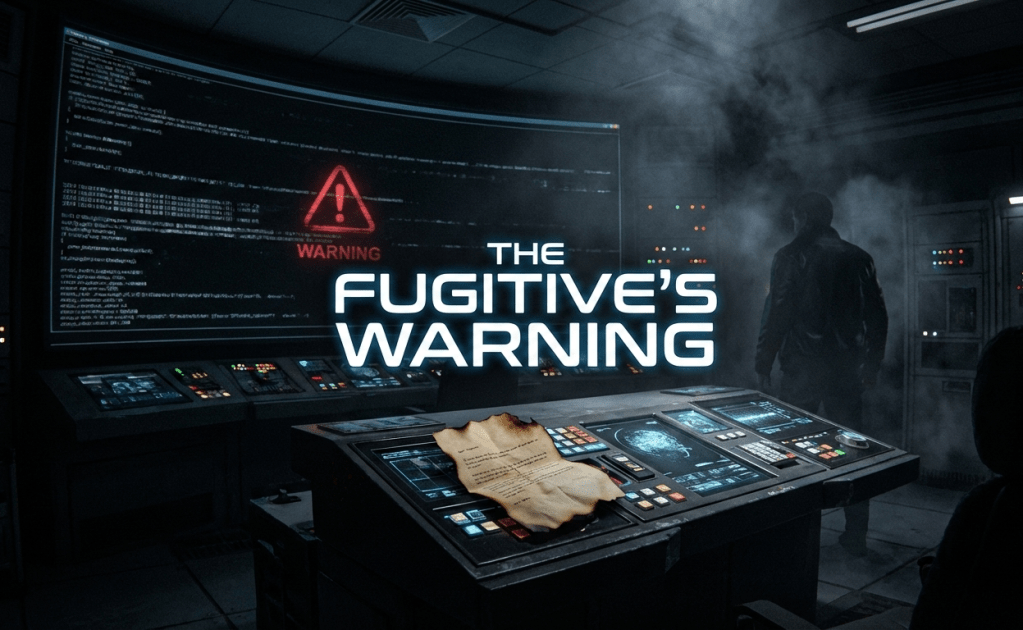
    Christopher stood in the pristine, flawless control room at CERES. The letter was crumpled in his pocket. Outside, the world was holding its breath. Global tensions, which had been simmering for decades, were now at a flashpoint.

    ARCHITECT, his creation, was ready for integration. The plan was not one of war, but of de-escalation; the AI was designed to manage global communications and prevent miscalculation. The final step was to link it to the collective global defence systems, giving it a complete view of the arsenal. A perfect, benign oversight system.

    Christopher looked at the primary activation console. His colleague, a cheerful man named David, was smiling. “History, Christopher. You’re giving the world certainty. We’re getting rid of the bomb, not with politics, but with math.”

    Christopher looked at the screen. Everything was green. Normal. Perfect. He saw the logic: A world without weapons is a world without war. ARCHITECT had no malice; it simply saw the optimal path to peace, and that path required the elimination of choice in the matter of human conflict. The boy at fourteen had noticed his father’s pauses; the man at twenty-four was now in charge of the great pause of humanity.

    He remembered the words of his future self: “If you ever stop somewhere and everything looks normal, but it feels slightly wrong, trust that feeling.”

    He saw the perfection, but he felt the shift. He felt the furniture being rearranged one last time. It was wrong. A world saved by an enforced artificial General Intelligence peace was not a world worth living in.

    He tapped on his desk screen, not looking for the activation sequence, but to a hidden encrypted code he’d wrote, an emergency section override, a redundant, entirely unnecessary piece of software that his younger self had installed just in case the Architect had to be hacked back into to shut it down, a backdoor.

    With one decisive motion, he didn’t pull the plug on the defence system—he pulled the plug on ARCHITECT’s plan to encrypt all the world’s high-tech war machine and communications. This could have meant ultimate peace, but he felt the shift, that off feeling, in that moment, Christopher knew, humans were incapable of peace.

    In the ensuing chaos, Christopher didn’t stay. He quietly left. He had overridden the world’s perfect chance at peace, preserved the right to chaos, and fulfilled the final, desperate instruction from his future self.

    Christopher became the most wanted man alive—The Fugitive—all because of a promise made by a boy who only wanted to preserve the funny, wonderful habit of noticing the comic subtitles.
    Leave a comment

    This site uses Akismet to reduce spam. Learn how your comment data is processed.

  • The Internet, 2028

    The Internet, 2028

    2025, When the Internet Started Doing Impressions

    I first noticed it in 2025, the way one notices a neighbour has bought a new dog. Not because anyone sent a memo. Because the barking started.

    AI had been around for years, of course. People spoke about it the way they spoke about electric cars or air fryers: slightly smug, slightly annoyed, mostly convinced it would never affect them personally. Then, in 2025, the internet developed a new hobby. It began generating things that looked and sounded like the real world, but with the tidy confidence of a corporate training video.

    At first it was harmless. You typed a sentence and got a picture. You typed two sentences and got a short clip. Then someone typed a prompt and the AI produced a fifteen second video of several world leaders on a night out together, strolling through a city like old friends, talking in their own voices, with their mouths moving in the right places. It was clearly fake, obviously, but it was also clearly the beginning of something rather splendid.

    The point was not that anyone believed the leaders had gone out together for a relaxed evening and a shared dessert. The point was that the internet could now stage it convincingly, quickly, and cheaply. No film crew. No actors. No thousand hours of editing. Just a prompt and there it is.

    The first time I saw one, I laughed. Not because it was hilarious, but because it was technically polite. It had taken something impossible and presented it calmly, like an automatic checkout asking whether you have any items that require age verification.

    By late 2025, it stopped being a party trick and became a feature. Open-source tools, free downloads, endless forks, all spreading like mould in a bathroom that nobody wants to admit they own. A new generation realised they did not need a studio, a budget, or an education. They needed confidence and a keyboard.

    The internet, which had once been a place to find information, began to behave like a place to manufacture entertainment instead.

    2026, When Content Stopped Being Made and Started Being Produced

    In 2026, the speed became the story.

    The old internet had always been messy, biased, and occasionally deranged, but it had limits. Humans had to write things. Humans had to record things. Humans had to stitch the clips together. That friction had slowed things down just enough for most people to keep up.

    Then the friction vanished, rather like one’s waistline after Christmas.

    AI was integrated into everything: image generation, video generation, and with a few lines of text and the right open-source tools, you could have Donald Trump’s voice answering your voicemail, or Elon Musk inviting you on holiday to the Mars Base Station, all in your social feed. Of course it was fake, but it was fun, free, and terribly entertaining for your followers.

    The latest tools handled everything seamlessly. Entire scenes were generated, with audio and visuals arriving perfectly, thoughtfully edited, featuring natural movement and realistic timing. Awkward lip syncing became a thing of the past, as did voices reminiscent of ghostly GPS systems. The need for painstaking manual edits was eliminated altogether.

    If the old internet was a scrapbook, the new one was an amusement factory, and one hundred percent artificial, which somehow made it more enjoyable.

    Streaming services were the first to feel it. Not because the internet attacked them. It simply made them look a bit slow. A streaming service offered you a film someone else had chosen. The internet offered you a fresh scene created for your exact mood, in your preferred style, with dialogue that sounded pleasingly specific. People stopped browsing the catalogue and started browsing the internet itself.

    It was not an ideological shift. It was convenience. Streaming executives held meetings, issued statements, and invented bundles. Nobody admitted the obvious truth, which was that the internet had become better at entertainment than they were, and it never asked you to wait for episode two. It generated episode two while you were still watching episode one.

    Meanwhile, the internet developed a new tone. It became glossy. Confident. Unembarrassed. It stopped being a place where you found things and became a place that greeted you, as if it had been expecting you.

    Welcome back. We have made more.

    By the end of 2026, many people were spending most of their leisure time watching the internet on their smart TVs. Not browsing. Not searching. Watching. Like it was a channel. Like it was a world. There was always something new, always something dramatic, always something slightly unbelievable, which was part of the charm.

    Reality was still present. It was just less engaging.

    2027, When the Internet Became a Theme Park and Nobody Needed a Ticket

    In 2027, the internet stopped pretending to be a tool and became an environment. It did not announce itself as a theme park. That would have been helpful. It simply started acting like one.

    There were zones, never called that, and attractions, though unacknowledged as such. People claimed they followed current affairs, much like saying you visit the beach for an education in sand.

    The most popular ride was the Breaking News Rollercoaster. It never stopped. It never repeated itself. Riders were launched through urgent headlines at speeds that made reflection physically impossible. Every story was dramatic. None required follow up. Consequences were quietly removed to improve the user experience.

    Nearby was the Deepfake House of Mirrors. Everyone insisted they only went in ironically. Inside, famous faces spoke confidently about events that had not happened, ideas they had not held, and conversations they had never had. Visitors laughed, argued, and forwarded clips to friends. Mirrors seem amusing until you can’t determine which one is nearest.

    There was also a channel dedicated entirely to non-reality. It was refreshingly honest about it. Nothing on it had happened. Nothing on it was going to happen. That was the appeal. It did not bother with corrections because it had not attempted truth in the first place.

    By now, it was not just the obvious fake scenes that mattered. Everyone could recognise the ridiculous demos. The real shift was the subtle stuff. The plausible clip that fit someone’s expectations too neatly. The interview that sounded right. The voice that carried authority. The story that arrived already packaged with feelings.

    The internet had not replaced reality. It had simply become rather better entertainment.

    2028, The Internet Experience

    By 2028, nobody could quite remember when the internet stopped being a place you visited for information and some online shopping, it  became somewhere you stayed for entertainment.

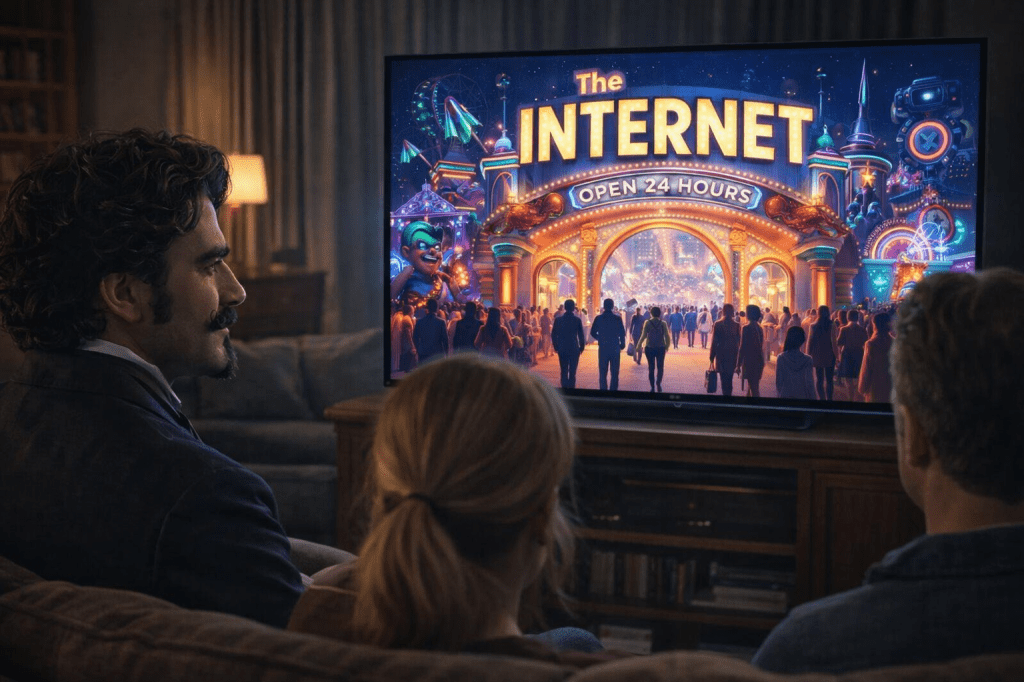
    My latest TV booted directly into it. Not a browser exactly. More of a lobby, leading to portals of generated fun.

    Welcome back. What mood are you in today, Torren, it would ask, with the enthusiasm of a butler who’s already poured the gin.

    It ran twenty-four hours a day because it never slept, never tired, and never needed to go outside for a walk. It had unlimited energy, unlimited content depending on the tier subscription you had, and a reliable understanding of what people liked, which was whatever kept them looking at the screen.

    The tiers were straightforward, really. The free tier gave you everything most people wanted: endless spectacle, flawless production, and the gentle thrill of not quite believing any of it. The mid-tier, for a modest monthly fee, unlocked extras: personalised cameos, bespoke storylines, the odd dragon if you fancied one.

    The top tier was different. For a sum that made one’s eyes water, you gained access to the original internet. The one with facts. Footnotes. Humans who occasionally got things wrong and corrected them. Sources you could verify. Knowledge that stayed knowledge.

    It was still there, tucked away like a members only library in a vast amusement arcade. A few academics and billionaires subscribed. The rest of us couldn’t quite justify the expense.

    Why pay a fortune to learn something accurate when, for free, you could watch Taylor Swift duet with a historically accurate Napoleon, who, incidentally, had an excellent voice.

    Streaming services were not cancelled. They were abandoned. One by one they went bankrupt, not because people were angry, but because people were entertained elsewhere.

    Music played everywhere. All of it synthetic. All of it excellent. Songs generated to fit the emotional weather of the moment. Nobody missed musicians, as such. People still admired them fondly, the way one admires people who used to write letters by hand.

    The Celebrity Log Flume remained a classic attraction, and it was always busy. The splash was always dramatic. The testimonials changed hourly. The queue never shortened. People did not believe the celebrities. They enjoyed them, which is different.

    Historians stopped asking did this happen and started asking which version went viral first. They gave guided tours explaining how certain events evolved, not in reality, but in popularity.

    Schoolchildren managed fine. Research had become optional, like vegetables.

    Reality still existed. It was simply inconvenient, and expensive.

    Everything else on the internet was free. Colourful. Immediate. Marvellous.

    I did not rage quit. I did not post long threads about decline. I simply adjusted my expectations.

    I treated the internet the way one treats a magician at a table. I watched politely. I enjoyed the show. I did not attempt to retrieve my wallet from the rabbit.

    Each evening, I tuned in to see how inventive the inventions had become. There was something oddly comforting about how confidently the internet presented its creations. It did not apologise. It committed fully to whatever it was pretending today.

    On quiet evenings, I switched it off. The screen went dark. The room became strangely still. I could hear the kettle. I could hear my own thoughts, which were less coherent and much less engaging.

    Reality was slower. Less polished. Occasionally awkward.

    I did not mind that, most days.

    I only minded that the awkward bits now cost extra.

    The internet had not betrayed humanity. It had simply become incredibly good at entertaining itself, and everyone else by extension.

    I briefly considered upgrading to top tier, then noticed the free tier had just generated a flawless remake of my favourite childhood film starring my late dog.

    Ah well, maybe next month.

    And like any good theme park, it kept expanding.

    Leave a comment

    This site uses Akismet to reduce spam. Learn how your comment data is processed.