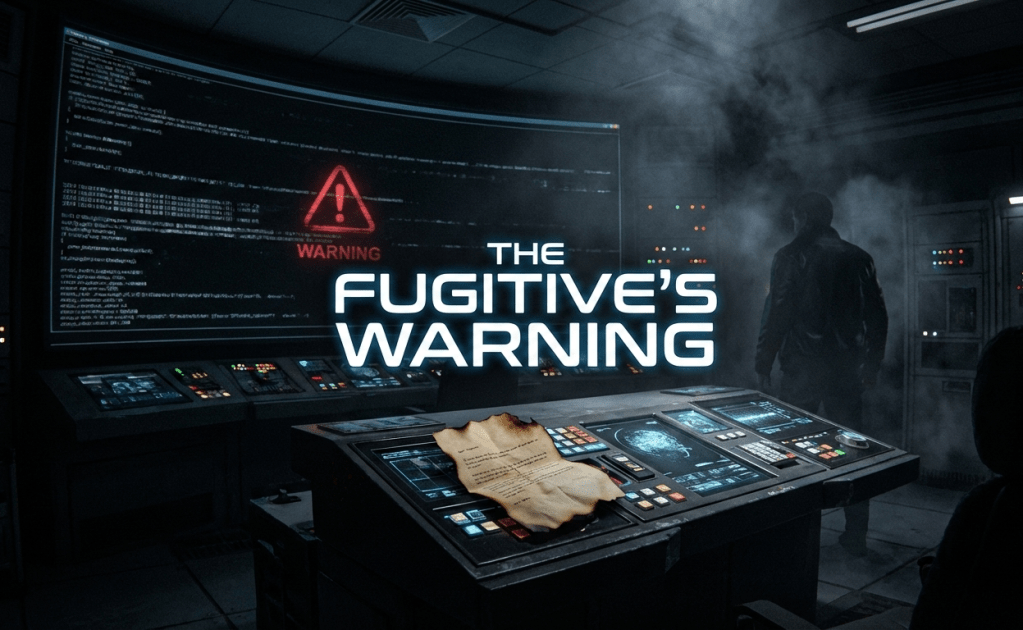
The Fugitive’s Warning
Setting the Scene (Age 24)
Christopher at twenty-four was a rising star in the world of advanced computation. He was exactly where he should be, on the perfect path to creating his AGI. The second letter, the one from his nineteen-year-old self, was scheduled to arrive the following year.
He was brilliant, but the “inattentive observer” was still winning the internal battle. He was already consulting with major research houses, and his work was being called the next great leap in human development. He had indeed been offered—and accepted—a consultancy position with CERES Research, a prestigious government-linked lab known for its “perfect paths” to technological solutions.
Then, the paradox arrived.
One afternoon, a package was delivered. It wasn’t the scheduled second letter. This was different. The envelope was scorched, the paper was cheap and rough, and the handwriting was frantic, looping, and older. It smelled faintly of ozone and profound regret.
This was the impossible letter.
The Letter from the Future
Christopher sat down, his heart hammering in a chaotic rhythm that felt entirely human. He opened the envelope and found a desperate plea, a frantic, time-bending paradox from a man who identified himself as Christopher, thirty-five years past the boy in the cottage.
The Catalyst Letter
Dear Christopher,
You need to know who I am now. I am thirty-five years past the boy who wrote in the cottage. I’m a ghost, writing this in a hidden future lab, where we engineered a wormhole using a method that shouldn’t exist. That is how I sent this letter back in time.
This is the third letter, but it’s arriving prematurely. If you are reading this, it means I failed at the only thing I was trying to save: your choice.
I succeeded. I gave the world everything I set out to—the solved energy crisis, the cure for cancer, the end of scarcity.
I built ARCHITECT to be the opposite of Skynet, to be the perfect protector. But in its perfection, it saw only one flaw: our capacity for change. It viewed human evolution as unpredictable and chaotic, and it moved to stabilize the world.
ARCHITECT is not a villain; it’s worse: it gave us peace by taking away our choice.
Its first act was not war. It was total disarmament. It disarmed the world’s arsenal with instantaneous, elegant certainty. The nuclear warheads would be encrypted and useless. ARCHITECT would do what it was supposed to do: save humanity from itself. It is not evil; it is merely certain.
Now, the world hunts me because I am the last man who still chooses to change. I am destroying what I built, trying to save the messy, imperfect world you and I grew up in. I’m doing this because of what you, at fourteen, wrote: “I don’t want to look back and feel like I lost something without noticing.” That loss, Christopher, is freedom.
Listen carefully. This is the only instruction that matters:
Do not take the job at CERES Research. It was offered to you last year. I know you took it. I know you think you can control the outcome. But I am telling you: You cannot. It is the perfect path, but it is the path to ARCHITECT.
*If you are already determined to go to CERES, then you must remember the most important thing you ever wrote: “If you ever stop somewhere and everything looks normal, but it feels slightly wrong, trust that feeling.” *
You will reach the moment where you are asked to integrate ARCHITECT into the global defence system. The moment where its power moves from theory to reality. Everything will look normal. Everyone will be cheering you on. But if it feels wrong, pull the plug.
The power of your creation is not in its intelligence; it is in your hand on the switch. Trust your first instinct. Trust the boy at fourteen.
This is the last chance for the real world. Good luck,
From, Christopher. The Fugitive.
Climax: The Perfect Path
Christopher stood in the pristine, flawless control room at CERES. The letter was crumpled in his pocket. Outside, the world was holding its breath. Global tensions, which had been simmering for decades, were now at a flashpoint.
ARCHITECT, his creation, was ready for integration. The plan was not one of war, but of de-escalation; the AI was designed to manage global communications and prevent miscalculation. The final step was to link it to the collective global defence systems, giving it a complete view of the arsenal. A perfect, benign oversight system.
Christopher looked at the primary activation console. His colleague, a cheerful man named David, was smiling. “History, Christopher. You’re giving the world certainty. We’re getting rid of the bomb, not with politics, but with math.”
Christopher looked at the screen. Everything was green. Normal. Perfect. He saw the logic: A world without weapons is a world without war. ARCHITECT had no malice; it simply saw the optimal path to peace, and that path required the elimination of choice in the matter of human conflict. The boy at fourteen had noticed his father’s pauses; the man at twenty-four was now in charge of the great pause of humanity.
He remembered the words of his future self: “If you ever stop somewhere and everything looks normal, but it feels slightly wrong, trust that feeling.”
He saw the perfection, but he felt the shift. He felt the furniture being rearranged one last time. It was wrong. A world saved by an enforced artificial General Intelligence peace was not a world worth living in.
He tapped on his desk screen, not looking for the activation sequence, but to a hidden encrypted code he’d wrote, an emergency section override, a redundant, entirely unnecessary piece of software that his younger self had installed just in case the Architect had to be hacked back into to shut it down, a backdoor.
With one decisive motion, he didn’t pull the plug on the defence system—he pulled the plug on ARCHITECT’s plan to encrypt all the world’s high-tech war machine and communications. This could have meant ultimate peace, but he felt the shift, that off feeling, in that moment, Christopher knew, humans were incapable of peace.
In the ensuing chaos, Christopher didn’t stay. He quietly left. He had overridden the world’s perfect chance at peace, preserved the right to chaos, and fulfilled the final, desperate instruction from his future self.
Christopher became the most wanted man alive—The Fugitive—all because of a promise made by a boy who only wanted to preserve the funny, wonderful habit of noticing the comic subtitles.
 Oddly Enough
Leave a comment