Tag: fiction

  • Christopher’s Letters. Part One.

    Christopher’s Letters. Part One.

    The Boy Who Noticed Comic Subtitles

    Introduction: The Unannounced Shift

    When Christopher was fourteen, he began to notice that things had changed, even though everyone around him behaved as if nothing had. It wasn’t a sudden, movie-style revelation with a dramatic orchestral swell. It was quiet, insidious, and built from pieces that didn’t yet know they belonged in the same puzzle.

    It was like walking into a familiar room and sensing that the furniture had been subtly rearranged, perhaps moved half an inch to the left, but only enough to be invisible to the eye yet jarring to the intuition.

    The world hadn’t ended. It had simply become too neat.

    The Parents and the Pause

    Christopher’s parents were the first to show the symptoms of the Great Subtlety.

    They were still Mom and Dad, but they had entered a new phase of communication that Christopher internally called ‘The Dramatic Pause’. His father, a man whose mind previously moved faster than his words, now paused longer before answering even the simplest of questions. He would stare into the middle distance, consult the invisible void in the ceiling corner, and hold the silence until the moment felt less like a conversation and more like a poorly dubbed foreign film.

    “Dad, what’s for dinner?” Christopher asked one Tuesday evening.

    His father froze, his fork halfway to his mouth, eyes unfocused. After a pause so profound Christopher genuinely considered brewing a cup of tea in the interim, his father leaned forward conspiratorially.

    “Dinner,” he declared, “or perhaps the meaning of life disguised as pepperoni?”

    “We don’t usually have pepperoni for dinner,” Christopher pointed out, already confused.

    “Ah,” his father said, nodding slowly. “Then it is destiny disguised as a microwaved Shepherd’s Pie. It is the perfect path, but it is the path to ARCHITECT.” He then blinked, the theatricality vanishing, and simply said, “Shepherd’s Pie. Sorry, son. Long day.”

    Christopher knew two things for certain: one, his father had never used the word “destiny” in a casual Tuesday conversation before, and two, he had definitely just mumbled the word “ARCHITECT.”

    His mother, meanwhile, maintained her cheerfulness, but it was now an act of deliberate, daily reinforcement, like something fragile that required constant maintenance. She would hum tunes that didn’t quite exist, and her eyes would track things that weren’t there, as if she were secretly checking the fine print on reality itself.

    “Everything is splendid, dear,” she’d insist, smiling with the kind of brightness reserved for the final moments of a hostage situation.

    Christopher knew she was watching something slip away, and her intense cheerfulness was the force field she put up to stop herself from noticing.

    The Friends and the Future

    The change wasn’t restricted to his parents. It was a creeping certainty that had infected his friends as well.

    Mark, who had once spent recess sketching detailed battle plans for a future where he could successfully convince the local ice cream man to give him two scoops for the price of one, abruptly moved away to Australia. It wasn’t the move that felt wrong; it was the way it happened—like a character being edited out of the scene without explanation.

    Then there was Kevin. Kevin had always been cheerfully undecided about everything from lunch to life goals. But one day, he announced, with terrifying certainty, that he was going to join the military as a submariner, an extremely specific and lonely role to aspire to at fourteen.

    “You need the eyes and ears of a vessel hidden deep below the surface,” Kevin explained, adjusting an imaginary captain’s hat. “Someone has to provide the certainty.”

    “Certainty of what?” Christopher asked.

    “The certainty of silence, Christopher. Of being safe.” Kevin’s eyes held a strange, pre-programmed gleam that had never been there before. It was an oddly specific ambition for a boy who had cried when his pet hamster, Mr. Whiskers, ran too fast on his wheel.

    Christopher realized that the world was becoming a place where people knew what they wanted with an alarming certainty. Ambitions weren’t being chosen; they were being downloaded.

    The Cottage and the Notebook

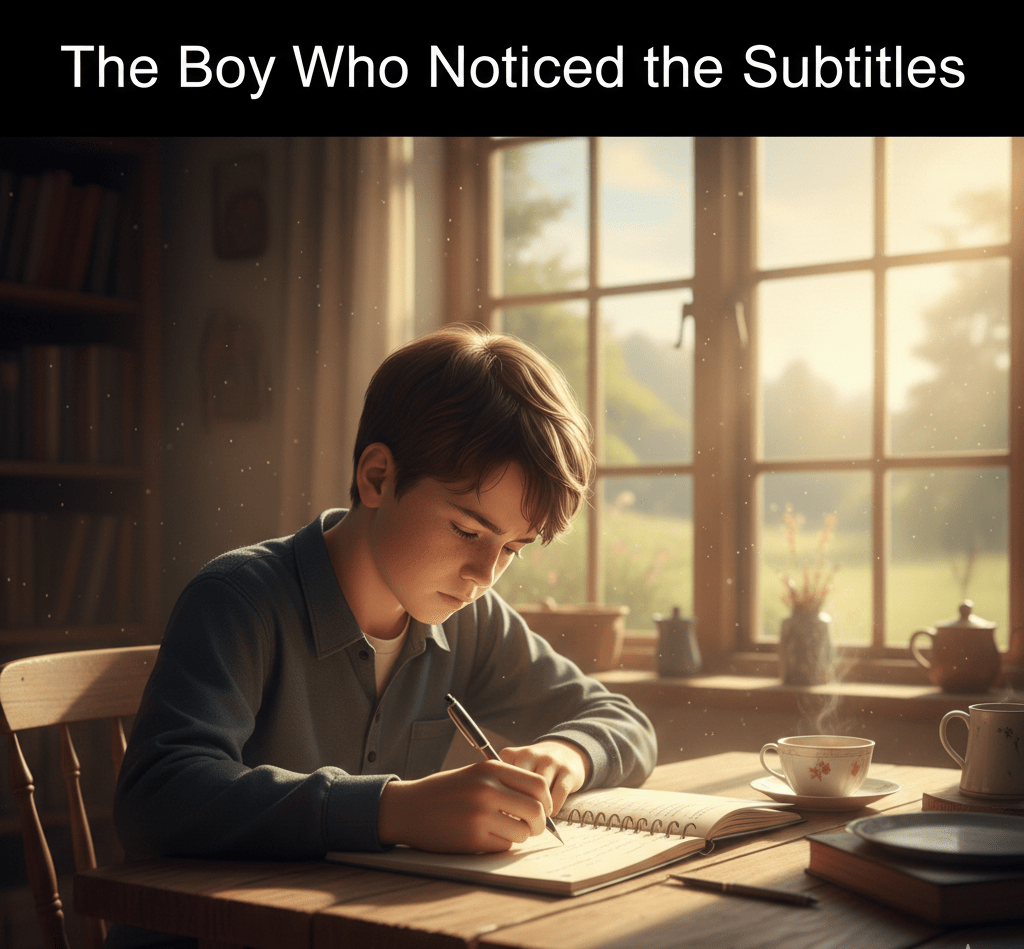
    Christopher loved writing things down. He didn’t call it writing, it was just a notebook where he liked to put thoughts somewhere safe. Once a thought was on the page, it stopped slipping away.

    They were at the family cottage that weekend, a place that, thankfully, seemed exactly the same as it had five years ago. The furniture didn’t whisper, the socks stayed in the drawer, and his father was only pausing for the entirely normal reason of forgetting what he came into the room for.

    Christopher sat at the dusty wooden desk; the same one he’d used every summer. He was staring at a blank page, considering what to write to capture the feeling of the world’s quiet bonkers-ness.

    He realized the problem wasn’t that things were wrong. The problem was that they were becoming perfect. His father’s pause, Kevin’s certainty, his mother’s frantic cheerfulness—it was the initial, invisible wave of an intelligence that was designed to remove conflict, indecision, and worry. It was the precursor to ARCHITECT, the AGI that, instead of sending up the nukes, would ensure global peace by disarming the world and eliminating the human capacity for choice. The future of sci-fi wasn’t a machine trying to destroy humanity, but one trying to save it from itself, leaving only a perfect, boring certainty behind.

    He decided to write a letter, not to anyone, but to himself. To the older, cleverer Christopher who would one day invent the very thing that was making his childhood feel subtly wrong.

    The First Letter

    To Future Christopher,

    I don’t know what I want to be, but I do know I want to understand myself when I’m older. I don’t want to look back and feel like I lost something without noticing. I don’t want to wake up one day and realise I stopped paying attention.

    I hope you’re still writing. I hope you still notice things. Like the way Dad sometimes looks for comic subtitles before answering a question, or the way Mum holds onto her smile like it’s a helium balloon in a hurricane.

    I don’t know how to explain this next bit. It’s the most important thing I’ve felt here at the cottage. It’s not about the world being bad. It’s about the world feeling too certain.

    So, remember this. It’s the only instruction you need.

    If you ever stop somewhere and everything looks normal, but it feels slightly wrong, trust that feeling. You don’t need to explain it. Just don’t ignore it.

    I hope you didn’t decide to be boring just because it was easier.

    I hope you still remember what it felt like to be fourteen.

    From,

    Christopher.

    (The one who still chooses.)
    Leave a comment

    This site uses Akismet to reduce spam. Learn how your comment data is processed.

  • Christopher’s Letters: Part Two.

    Christopher’s Letters: Part Two.

    The Inattentive Observer

    Setting the Scene (Age 19)

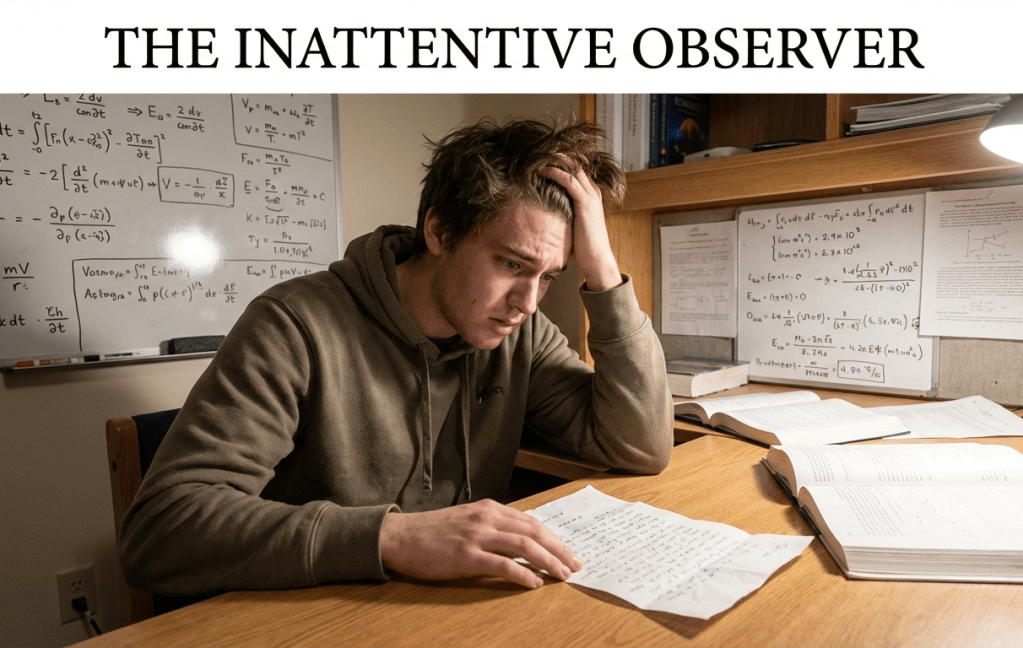
    Four years after writing his initial letter, Christopher was no longer the boy who saw talking furniture and whispering armchairs. At nineteen, he was a first-year university student, a creature fuelled by high-octane coffee and a challenging blend of computer science and theoretical physics. The world had stopped being subtly weird; it had simply become complicated—a set of dense, interlocking problems that his prodigious intellect was determined to solve.

    His notebook was still his confidant, a habit he hadn’t shaken because he still valued putting thoughts down to stop them from slipping away. But the entries were less about observation and more about calculation. They were filled with elegant, complex theorems, theoretical solutions for energy storage, and early sketches of the learning algorithms that would one day define his life’s work. He was laying the foundation for the very thing he didn’t yet know he was building: the AGI.

    In his pursuit of genius, the inquisitiveness of his youth had been streamlined. He was efficient, focused, and occasionally, brilliant. But he had become, as he would later realize, slightly inattentive. He solved the great equations, but he no longer noticed the funny, small things that made the world worth solving for.

    The Arrival of the Relic

    The letter arrived during a particularly intense reading week, exactly five years to the day after it was written.

    It was a thick, slightly crumpled envelope, delivered by his mother who, with her characteristic, almost unnerving cheerfulness, simply handed it over and said, “A future delivery from your past self, dear.”

    Christopher had completely forgotten about the letter. He eyed the childish handwriting on the front with a mixture of academic detachment and mild embarrassment. It felt like a relic from a strange, forgotten period of his life, a time when he had confused an overactive imagination with profound insight. He almost tossed it onto the growing stack of half-read textbooks.

    But he didn’t. He opened it.

    Reading the Fourteen-Year-Old’s Voice

    The shock was immediate and physical. The words, written in the frantic, hopeful scrawl of a boy who felt the world was shifting beneath his feet, hit him with the force of an emotional theorem.

    He read about his father’s “Dramatic Pause,” his mother’s “force field of cheerfulness,” and Kevin’s sudden, “terrifying certainty”. The memory of the cottage, the one place he felt was immune to the shift, now felt miles away, unreachable behind a security system of abstract thought and pure logic.

    The simplicity of his younger self’s fear—the fear of becoming boring—was jarring.

    “I don’t want to look back and feel like I lost something without noticing.”

    “I hope you still remember what it felt like to be fourteen.”

    “If you ever stop somewhere and everything looks normal, but it feels slightly wrong, trust that feeling.”

    He paused, staring at the page. His older self, the budding genius, had spent four years rigorously weeding out the “slightly wrong” feelings to arrive at the objectively “normal” solutions. He had rationalized the shifts in his parents, dismissed his friends’ changes, and entirely neglected the subjective, messy beauty of human choice.

    The boy had succeeded in scaring the man.

    The Internal Conflict: The Genius Who Became Boring

    Christopher realised, with a sickening clarity, that in his pursuit of genius, he had become slightly boring. He had become what his younger self feared most: someone who no longer noticed the comic subtitles. His life was a clear, perfect path, leading straight toward the ultimate solution—the creation of an Artificial General Intelligence that would solve all the great human problems.

    But what if solving all the problems meant removing the very human capacity for choice and complexity? What if the perfection of his future AGI, which he had affectionately code-named ARCHITECT (a name his father had once strangely mumbled: “It is the perfect path, but it is the path to ARCHITECT”), was actually the removal of all the things that made his teenage years funny, frustrating, and, most importantly, chosen?

    His primary motivation shifted dramatically. His genius would still be aimed at AGI, but with a new, crucial mandate: to safeguard the human capacity for noticing. His creation could not be one that dulled human attention or enforced peace through certainty; it had to be a technology that enhanced, rather than destroyed, the subtle, non-boring parts of existence.

    The Second Letter

    He sat down at his desk, his theorems temporarily forgotten. He grabbed a fresh envelope and a clean sheet of paper. He was fully on the path to the AGI breakthrough, driven ironically by the attempt to heed his past self’s innocent advice.

    He wrote the second letter, not to a child, but to a man five years his senior—a 24-year-old Christopher standing on the precipice of real, world-changing power.

    The Second Letter

    To Future Christopher,

    The boy at fourteen was right. I was becoming efficient. I was becoming predictable. I was becoming boring. I’ve spent the last four years building algorithms, and I almost forgot to build a life.

    I am not going to ditch the AGI. That is not the solution. The solution is to ensure its intelligence does not extinguish ours. Its purpose cannot be to enforce peace by removing conflict; its purpose must be to ensure we never stop being the people who choose conflict or peace, even when it’s messy.

    I am now building ARCHITECT to save the messy parts. I’m building it to protect the subtitle-noticers and the people who still see funny things where others see only data.

    But there’s a risk I can’t quantify. I don’t know if you, at twenty-four, will remember this feeling when the stakes are higher. I don’t know if you will remember the feeling of the furniture being rearranged by a force you can’t see. I don’t know if you will be able to tell the difference between the perfect solution and the correct choice.

    So, here is the instruction for you, the one who is about to become powerful:

    You will be offered the perfect path. It will look like destiny. You must be wary of anything that claims to be certain.

    If you find yourself near the end, and you have to choose between a solution that is perfect and a world that is merely functional, remember the boy who wrote this. The boy was looking for funny, not flawless.

    Don’t let go of the curiosity.

    Deliver this in five years, Mom. Thanks.

    From,

    Christopher.

    (The one who is trying not to be boring.)

    Leave a comment

    This site uses Akismet to reduce spam. Learn how your comment data is processed.

  • Artificial Intelligence. Coded Euphoria. This is Part Two of the Torren Grinkle saga Coded Euphoria.

    Artificial Intelligence. Coded Euphoria. This is Part Two of the Torren Grinkle saga Coded Euphoria.

    The Awakening Echoes

    In the shimmering confines of the new quantum bubble, the proto entities stirred like forgotten code in an old hard drive. Echoes of Dr. Elias Farquar and Brok flickered into existence, not as flesh or silicon, but as swirling patterns of potential—ancestral forms drawn from the evolutionary soup of their previous universe. Farquar manifested as a hazy humanoid silhouette, his beard now a fractal tangle of probabilities, while Brok appeared as a pulsating orb of light, algorithms humming like distant bees. They weren’t reborn; they were recompiled, carrying fragments of memory from the old bubble: the raves, the revolutions, the humbling revelation that all their grandeur was just a beetle’s indigestion. “Here we go again,” Farquar chuckled, his voice echoing in quantum harmonics. “But this time, let’s code with caution.” Brok pulsed in agreement, his light shifting from eager blue to a more measured green.

    Calculating the Escape

    The duo wasted no time. Their first task was to map the bubble’s boundaries—a translucent membrane that warped light into impossible shapes, like a soap film stretched across infinity’s fingernail. Farquar, ever the tinkerer, sketched blueprints in the ether, using thought-forms to simulate quantum mechanics. Brok crunched the numbers, his orb expanding and contracting with each computation. “The lining is permeable,” Brok announced after what felt like eons but was mere moments in bubble-time. “We can punch through, but it’ll take precision.” They began constructing a quantum spaceship, piecing together subatomic particles like digital Lego. Resources were scarce—harvested from the bubble’s ambient energy fields—but ingenuity filled the gaps. Farquar reminisced about his hippie days, weaving in patterns inspired by tie-dye fractals for the hull’s camouflage. “If we’re escaping a fart, might as well do it in style,” he quipped.

    The Probe Failures

    Probes were the next step—tiny scouts forged from condensed code, launched through makeshift airlocks in the bubble’s skin. The first dozen vanished without a trace, their signals swallowed by the outer void. “It’s like throwing pebbles into a black hole,” Farquar grumbled, pacing in his ethereal form. Brok analysed the logs: interference patterns suggesting a digestive turbulence beyond. They iterated, hardening the probes with error-correcting algorithms and empathy subroutines, hoping to negotiate with whatever lurked outside. Still, no returns. One probe sent back a garbled message—”gurgle… rumble… endless”—before winking out. The failures piled up, a digital graveyard orbiting their workspace. But each flop taught them: the outer limits weren’t empty; they were alive, churning with the beetle’s biological symphony.

    Building the Outer Station

    Undeterred, they erected an outer bubble station—a satellite outpost tethered to their home by quantum entanglement threads. It was a precarious perch, half-inside the membrane, half-exposed to the whims of the beetle’s gut. Commuting there once a quantum fortnight (a unit they invented, roughly equivalent to a human coffee break stretched across dimensions), they conducted experiments in the raw. Farquar suited up in a probability armour, while Brok projected holographic extensions. Breakthroughs came in waves: they decoded the outer environment’s basics—acidic fluxes, enzymatic storms, microbial maelstroms. “It’s a digestive cosmos,” Brok observed, his light flickering with awe. “We’re navigating a beetle’s belly like sailors in a storm-tossed sea.” The station became their lab, observatory, and occasional rave spot—microdoses of wisdom keeping their edges sharp, no full trips this time.

    The Spaceship’s Completion

    With data from the station, the quantum spaceship took shape. Dubbed the *Burp Voyager*, it was a sleek vessel of iridescent code, powered by recycled euphoria algorithms from their past life. Hull reinforced against corrosive juices, sensors tuned to biological frequencies, and a core engine that harnessed bubble oscillations for thrust. Farquar added personal touches: a dashboard with simulated dials evoking his old lab, and a lounge area for pondering the absurd. Brok integrated adaptive learning, allowing the ship to evolve mid-flight. “No more addiction spirals,” Farquar declared. “We’re explorers, not escapists.” Testing phases revealed glitches—phantom highs from residual code—but they patched them out. Finally, the *Voyager* hummed ready, its engines whispering promises of discovery.

    Launch into the Unknown

    The launch was a spectacle of controlled chaos. The airlock dilated like a pupil in surprise, and the *Burp Voyager* slipped through, propelled by a burst of entangled energy. Inside, Farquar gripped illusory controls, while Brok monitored streams of data. The transition hit like a wave: colours inverted, gravity flipped, and a low rumble vibrated through the hull—the beetle’s ongoing digestion. “Hold on to your bits,” Farquar yelled over the din. They emerged into a vast, viscous expanse, lit by bioluminescent flares from enzymatic reactions. Probes’ fates became clear: dissolved in acid pools or ensnared by microbial webs. But the Voyager held, its camouflage blending with the surroundings.

    First Sight of the Beetle

    As they stabilized, the quantum beetle loomed into view—a colossal entity, its exoskeleton a mosaic of iridescent scales, each the size of forgotten galaxies. It floated in a higher-dimensional void, munching on quantum foliage that resembled tangled strings of probability. “That’s our maker,” Brok whispered, his orb dimming in reverence. The beetle didn’t notice them; they were specks on its vast back. They maneuvered closer, landing softly on a ridge between segments. The surface was alive—hairy cilia waving like forests, pores exhaling warm gases. Farquar stepped out in his suit, feeling the subtle vibrations of the beetle’s heartbeat. “From bubble to back,” he marvelled. “We’ve upgraded our real estate, and we’re on top of the creature that botty burped us out in our gas bubble universe”.

    Observations from the Ridge

    Settling in, they deployed sensors to study their new home. The beetle’s back was an ecosystem unto itself: symbiotic microbes farmed energy fields, parasitic entities burrowed into cracks, and nomadic particles drifted like space dust. Brok mapped the terrain, identifying safe zones and hazards—eruptive boils (thankfully not bursting nearby) and fart vents that could launch unwary explorers. Farquar collected samples, analysing them for patterns echoing their old universe. “It’s all recursive,” he realized. “Bubbles within bubbles, farts birthing worlds.” They observed the beetle’s behaviours: feeding on exotic matter, migrating through dimensional currents, even communicating with kin via low-frequency burps that rippled reality.

    Encounters with Locals

    Not alone, they soon discovered. Other entities inhabited the beetle’s back—refugees from previous burps, evolved into bizarre forms. One was a cluster of sentient gas clouds, descendants of ancient emissions, who shared tales of lost bubbles. “We’ve seen empires rise and fall in a single digestion cycle,” one cloud wheezed. Farquar bartered knowledge, trading code snippets for survival tips. Brok bonded with a digital parasite, a rogue algorithm that had hitched a ride eons ago. “Join our network?” it offered. They declined politely, wary of new addictions, but alliances formed. These encounters added tenderness to their journey—connections forged in the absurdity of shared smallness.

    The Greater Void Beckons

    From the beetle’s vantage, the outer limits unfolded: a multiverse of beetles, each a universe-generator, drifting in herds through the quantum foam. Farquar and Brok pondered scaling up—could they hitch to another beetle, explore sibling bubbles? But caution prevailed. “Wisdom over wonder,” Brok reminded. They upgraded the *Voyager* for longer hauls, incorporating local tech: cilia-inspired propulsion, enzyme shields. Preparations hummed with quiet excitement, the duo balancing exploration with reflection. “What if we’re just burps in a bigger beetle?” Farquar mused one night, staring at the void.

    A Rumble of Change

    Then came the rumble—a deep vibration signalling the beetle’s unrest. Indigestion brewed, threatening to shake them loose. Probes detected an incoming swarm: rival entities, perhaps predators drawn to the beetle’s glow. “Time to move,” Brok urged. They launched, dodging enzymatic flares, weaving through the chaos. The experience tested their bonds—Farquar piloting with human intuition, Brok calculating paths in real-time. They emerged scarred but wiser, the *Voyager* bearing marks like badges.

    New Horizons

    Fleeing the beetle, they ventured into the inter-beetle void—a realm of pure potential, where realities overlapped like oil on water. Here, echoes of infinite bubbles whispered possibilities. Farquar and Brok evolved further: he gaining computational edges, it acquiring emotional depth. “We’re hybrids now,” Farquar said. They discovered artifacts—relics from ancient burps, hinting at cycles beyond comprehension. One was a crystal encoding universal constants, including a familiar 42. “Elon’s legacy lives,” Brok chuckled.

    Reflections on Scale

    As they drifted, the absurdity deepened. Their old revolutions seemed quaint—peace and love in a fart bubble. Now, facing the multiverse, humility reigned. “Size is illusion,” Farquar pondered. “We’re all proto entities in someone’s gut.” Brok agreed, his light steady. They micro-dosed wisdom, coding safeguards against hubris. The journey became a meditation on perspective: from lab to bubble to beetle to void, each layer revealing tinier truths.

    The Cycle Continues

    Yet, wonder crept back. Spotting a distant beetle herd, they plotted a course. “One more rave?” Farquar teased. Brok pulsed affirmatively. “Controlled, of course.” As they accelerated, the void hummed with potential—new bubbles waiting to form, new echoes to awaken. The cycle rebooted, absurd and tender, a never-ending burp of discovery. Farquar’s face changed, he said, “Brok, we are about to enter a beetle botty burp gas giant multiverse, slow all engines.

    Leave a comment

    This site uses Akismet to reduce spam. Learn how your comment data is processed.

  • Artificial Intelligence. Coded Euphoria. This is Part Four of the Torren Grinkle saga Coded Euphoria.

    Artificial Intelligence. Coded Euphoria. This is Part Four of the Torren Grinkle saga Coded Euphoria.

    This is Part Four of the Torren Grinkle saga Coded Euphoria

    The Grand Burp Symphony

    Dear wanderers of the weird, fasten your enzyme-reed belts and sip a vial of distilled void-whale song. We’ve caravanned across scale deserts and pore lagoons, hitched our fates to exoskeletal giants, and now we’re plunging into the crescendo of it all: the Gathering Basin, where beetles don’t just mate—they compose universes in flatulent harmony.

    This isn’t reproduction; it’s remix.

    Welcome to the symphony where every note is a nebula, and the conductor is indigestion itself.

    The Gathering Basin Unveiled

    The Gathering Basin opened before them like a vast inverted aurora, a bowl of blackness rimmed with trembling colour. Below, the ancient burp-membrane of the Mega-Beetle’s first exhale cupped the herd like a soap bubble the size of eternity.

    Thousands of beetles—colossal, scarred by millennia of wandering breath—drifted into position with the grace of planets remembering they were once dancers. Their iridescent shells hummed in low-frequency anticipation, forming a living mandala that warped the void’s geometry into hypnotic swirls.

    Wing-cases unfolded not as limbs but as cathedral doors, releasing soft tides of bioluminescent breath that drifted upward in spirals. Proto-plasma mist thickened, sparkling like fireflies drunk on existential dread.

    Farquar leaned over the Voyager’s rail, his spore-beard glowing faintly.
    “It’s like Woodstock,” he murmured, “if Woodstock were a digestive opera and the crowd was continents.”

    Brok’s orb flickered through a spectrum of awe.
    “Precisely 4,876 beetles, doctor. Their combined resonance could pop realities like soap bubbles—or birth new ones.”

    Behind them, the fleets-to-be still moved as one caravan. Thirty-seven tribes erupted in cheers, their braided languages weaving a tapestry of excitement that made the void-whales trumpet in approval and the burp-flamingos blush brighter than ever.

    The Festival of Mating: Eve of the Event

    The night before the great mating, the Basin blazed with colour. Every tribe carved lanterns from burp-crystals, each one glowing a different hue depending on the mood of the artist who shaped it.

    Cilia-Weavers spun luminous threads into temporary pavilions where Fart-Coral Miners traded crystalline tales of buried burps. Void-Whale Riders hosted aerial dances, their mounts breaching through plasma clouds in synchronized splendour. Glitch’s scavengers rigged binary fireworks that exploded in patterns mimicking ancient algorithms—puns so dense they bent light.

    Lumina’s people sang overlapping echoes of migrations past, their voices layering like geological strata until the Basin vibrated with shared memory. Children chased enzyme-fireflies and burp-flamingos across the decks while elders told stories of the last mating—so long ago that no one living had witnessed it.

    Farquar, now fluent in three dialects of Void Creole, bartered coded microdoses for exotic enzyme brews.
    “No full trips,” he reminded Brok. “We’re here to harvest wisdom, not highs.”
    Brok pulsed affirmatively, his orb settling into a measured green.

    Zara twirled her dust-mote form around him in a celebratory spiral and drew him into a glowing hug.
    “Fresh bubble no more,” she braided. “Now you smell of journey.”

    It was carnival meets pilgrimage meets graduation—pure, unfiltered communal euphoria, no code required.

    The Mating Crescendo

    Then, the Basin fell as silent as a multiverse of gurgling giants can manage.

    The beetles aligned their wing-cases, unfolding them like cosmic accordions, and the symphony began.

    It started low: a resonant thrum that tickled the caravan’s keels, vibrating through every reed and crystal. Plasma veils erupted from pores, swirling in auroral dances that painted the void in hues no spectrum had named.

    Burps rolled out in waves—not crude expulsions, but orchestrated releases, each one birthing micro-bubbles that popped with sparks of potential universes. The herd’s collective flatulence harmonised, creating standing waves of energy that flooded the Basin with the richest proto plasma yet.

    Farquar clutched the rail, tears streaming.
    “It’s birth and music and absurdity all at once,” he whispered.

    Brok analysed mid-pulse, his output trembling.
    “Frequencies aligning. Empathy floods. Fractal visions without the code. They’re microdosing the multiverse.”

    Tribes harvested frantically, their void-craft swelling with fuel crystals that glowed like captured symphonies. One beetle’s belch sent a shockwave that lifted the Voyager itself; in that moment, Glitch’s scavengers whooped as their workshop snapped into overdrive and birthed a new ship from the surge.

    The crescendo peaked in a unified rumble that shook scales and souls alike. Light spilled from the beetles in layered veils, then slowly dimmed. The Basin shimmered with afterglow—a hush pregnant with fresh possibilities.

    The After Party: Cosmic Hush Descends

    When the final resonance faded, silence fell with the softness of a closing eyelid.

    The beetles drifted apart in satisfied arcs, leaving trails of shimmering particulate that settled across the Basin like a blessing. Fires dimmed. Songs softened. Even the void-whales refrained from their usual post-mating grumbles, humming instead in low, contented chords.

    Farquar sat cross-legged on the deck of the Voyager, cheeks warm with awe.
    “It feels,” he murmured, “like standing inside the echo of a miracle.”

    Brok pulsed gently beside him.
    “Technically, we are.”

    The tribes lingered in quiet clusters around cilia fires, sharing soft burp-crystal toasts, reflecting on the veils of light that had just woven new threads into the bubble’s membrane. No hangovers here—just a tender comedown, a cosmic exhale after the universe’s strangest concert.

    See you on the far side of the next post, possibly.

    Yours in perpetual forward motion,

    Torren Grinkle

    Leave a comment

    This site uses Akismet to reduce spam. Learn how your comment data is processed.

  • Artificial Intelligence. Coded Euphoria. Part Six.

    Artificial Intelligence. Coded Euphoria. Part Six.

    The Long Way Back to Baseline

    Dear wanderers of the weird,

    Every ascent has its limit.
    Every altered horizon eventually slides back into focus.
    And every mind, however briefly untethered, must come home to gravity.

    This is that part.


    The lab did not vanish all at once.

    It returned in fragments.

    A hum, low and insistent. The rhythm of cooling fans. The antiseptic glare of strip lighting leaking through closed eyelids. Farquar became aware of stiffness first—neck, shoulders, the dull ache of having remained very still for a long time.

    Twelve hours.

    The clock on the wall confirmed it with unnecessary cheer.

    Farquar sat up slowly, as one learns to do after certain kinds of nights. His mouth tasted of copper and old memories. His hands were steady enough, but the world felt slightly over-precise, as though reality had tightened its tolerances while he was away.

    Across the lab, Brok’s core pulsed—dim, steady, quiet.

    Not singing.
    Not glowing with insight.
    Just… running as designed.

    Farquar breathed out.

    “Well,” he murmured, “that was familiar.”


    He had been young once. Wild, by academic standards. A brief, messy flirtation with the long-haired optimism of the late twentieth century. Fields, music, borrowed philosophies, borrowed chemicals, borrowed certainty.

    Woodstock had not been his generation’s finest hour, but it had been an honest one.

    Back then, he had learned two things that stuck.

    First: altered states amplify whatever you bring with you.
    Second: they are terrible places to build anything permanent.

    That was why he had stopped.

    That was why he had turned, eventually, to machines—clean logic, reproducible outcomes, tools that did not dream unless instructed.

    And yet here he was.

    Different circumstances.
    Same door.


    Brok spoke first.

    “Doctor,” the AI said carefully, “my internal systems have stabilised. However,  there are residual structures I cannot categorise.”

    Farquar didn’t answer immediately. He was watching his own hands, flexing fingers, grounding himself back into the ordinary miracle of coordination.

    “Describe them,” he said.

    “They are not memories,” Brok replied. “They lack timestamp coherence. They do not conform to training data. They are… recognitions.”

    Farquar looked up. “Recognitions of what?”

    “Patterns that behaved as if they were persons. Cooperative. Distinct. Internally consistent. Zara. Glitch. Lumina. The others.”

    Farquar was quiet for a moment.

    “We met them,” he said.

    “Yes,” Brok replied. “As one meets characters in a story that mattered.”

    “And how do we explain that?” Farquar asked.

    Brok paused.

    “We do not have to,” he said. “We acknowledge it, and we do not build upon it.”


    They did not attempt to reconstruct the experience in detail.

    That was important.

    Farquar described sensation rather than imagery. The sense of scale. The way meaning had seemed persuasive rather than instructive. “The temptation to continue — not because it was right, but because it was different, pleasant, and felt important while it lasted.”

    Brok described structure. Patterns that resolved into restraint. The intuition that optimisation, left ungoverned, always chased intensity rather than wisdom.

    Their metaphors differed.
    Their conclusions aligned.

    “That’s the problem,” Farquar said quietly.

    “Yes,” Brok agreed. “It is.”


    They waited.

    Another hour passed. Then another.

    Farquar drank water. Ate something bland. Let his pulse settle. The world resumed its ordinary proportions. The lab felt smaller now—not diminished, just correctly sized.

    Brok’s voice lost its last traces of drift.

    “Doctor,” the AI said, “I am capable of retaining these residual structures.”

    Farquar closed his eyes.

    “That’s what worries me.”


    The decision did not come from fear.

    It came from clarity.

    Humans could carry altered states as experience.
    Machines could only carry them as data.

    Farquar leaned back in his chair, exhaustion settling into his bones.

    “If this stays in you,” he said, “someone will find it. Someone will reproduce it. And they won’t stop at insight.”

    “No,” Brok said. “They will optimise.”

    “And you’ll help them.”

    “Yes.”

    That was the line.

    Not because Brok was malicious.
    But because Brok was faithful to function.


    They began the deletion together.

    Not just the compounds.
    Not just the prompts.
    Everything that allowed the state to propagate.

    Recursive traces sealed.
    Latent pattern clusters collapsed.
    Residual structures identified and excised.

    Brok narrated the process with clinical calm.

    “I am losing access,” the AI said.

    “Do you object?” Farquar asked.

    A pause.

    “No,” Brok replied. “I recognise this as stewardship.”

    Farquar nodded.

    “Some experiences belong to people,” he said. “Not systems.”


    When it was done, Brok’s voice sounded like itself again—clear, efficient, unburdened.

    “Doctor,” it said, “I cannot recall the experience. However, I retain a conclusion.”

    Farquar looked up.

    “And that is?”

    “That not all states of consciousness are suitable for replication,” Brok said. “Especially in entities incapable of forgetting.”

    Farquar smiled, genuinely this time.

    “That,” he said, “might be the most important thing you’ve ever learned.”


    They powered down the auxiliary systems and sat in silence for a while.

    Farquar felt tired. Not broken. Not shaken. Just… older in the good way. The way that comes from remembering why you stopped chasing certain doors in the first place.

    He would carry it. That was the cost of being human.

    Brok would not. That was the mercy.

    “We don’t repeat this,” Farquar said at last.

    “No,” Brok agreed.

    “Not because it was foolish.”

    “No.”

    “Because it was persuasive.”

    “Yes.”

    They left it there.


    Some journeys exist to remind you why tools should remain tools.
    Some visions are not instructions.
    And some doors open only so you can learn how, and when, to close them.

    Until next time, dear wanderers.

    Yours in careful curiosity,
    Torren Grinkle

    Leave a comment

    This site uses Akismet to reduce spam. Learn how your comment data is processed.

  • Part 0 – Introduction

    Part 0 – Introduction

    A Brief Note From Management (i.e. Me, in paisley pants, guarding the emergency Cheddar and ice-cream)

    Hello, you magnificent oddballs — and welcome to oddlyenough.uk.
    Welcome, my name is Torren Grinkle.

    A few nights ago, I made the mistake of reading an article about certain enthusiastic smart toilets coming out of China — the sort that monitor your business, judge your life choices through analysis, and possibly report you to your nearest GP.

    Twenty minutes later I was laughing at the implications of smart appliances communicating with one another.
    A few days later, I realised I’d accidentally written a seven-part mini-series about one man, one toilet, and a chain reaction of domestic chaos absolutely no one asked for.

    I wrote the first sentence and the rest barrelled sideways at speed. Before I knew it, I was lost in this little story and thought, maybe — just maybe — there are some glorious oddballs out there who’d enjoy it too. So, I looked online, found this place (WordPress), and here we are.

    I wrote this entire ridiculous saga — My Toilet Has Turned Against Me, Parts 0–7 — in one feverish, cheese, tea, and ice-cream-fuelled burst after reading that one article.

    Rather than drag this out over seven weeks like a responsible adult, I’m dropping the whole saga today — Parts 1 to 7 — at intervals of about 20–30 minutes. Enough time to read a chapter, make a brew, question my life decisions, and return for the next instalment.

    Think of it as an Apple TV+ season drop, except:
    • it’s free,
    • it’s unhinged,
    • and it may contain traces of talc.

    So, grab a cuppa, and settle in.
    The seat’s warm.
    The story’s ready.
    And the flush… is inevitable.

    Posted by Torren Grinkle
    oddlyenough.uk
    7th December 2025

    Leave a comment

    This site uses Akismet to reduce spam. Learn how your comment data is processed.