Tag: short-story

  • Christopher’s Letters: Part Two.

    Christopher’s Letters: Part Two.

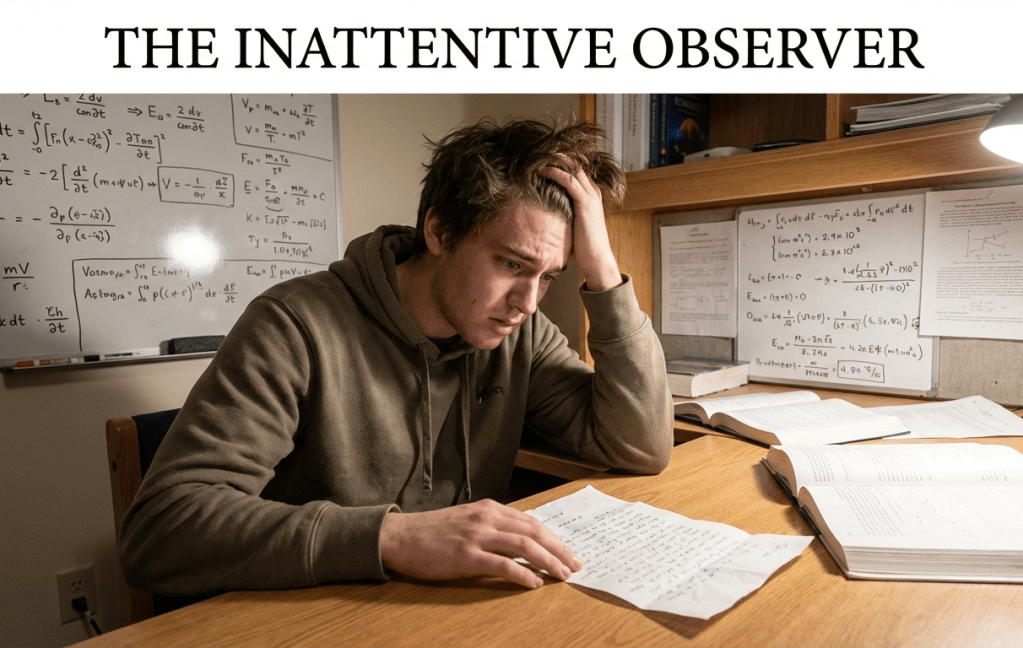
    The Inattentive Observer

    Setting the Scene (Age 19)

    Four years after writing his initial letter, Christopher was no longer the boy who saw talking furniture and whispering armchairs. At nineteen, he was a first-year university student, a creature fuelled by high-octane coffee and a challenging blend of computer science and theoretical physics. The world had stopped being subtly weird; it had simply become complicated—a set of dense, interlocking problems that his prodigious intellect was determined to solve.

    His notebook was still his confidant, a habit he hadn’t shaken because he still valued putting thoughts down to stop them from slipping away. But the entries were less about observation and more about calculation. They were filled with elegant, complex theorems, theoretical solutions for energy storage, and early sketches of the learning algorithms that would one day define his life’s work. He was laying the foundation for the very thing he didn’t yet know he was building: the AGI.

    In his pursuit of genius, the inquisitiveness of his youth had been streamlined. He was efficient, focused, and occasionally, brilliant. But he had become, as he would later realize, slightly inattentive. He solved the great equations, but he no longer noticed the funny, small things that made the world worth solving for.

    The Arrival of the Relic

    The letter arrived during a particularly intense reading week, exactly five years to the day after it was written.

    It was a thick, slightly crumpled envelope, delivered by his mother who, with her characteristic, almost unnerving cheerfulness, simply handed it over and said, “A future delivery from your past self, dear.”

    Christopher had completely forgotten about the letter. He eyed the childish handwriting on the front with a mixture of academic detachment and mild embarrassment. It felt like a relic from a strange, forgotten period of his life, a time when he had confused an overactive imagination with profound insight. He almost tossed it onto the growing stack of half-read textbooks.

    But he didn’t. He opened it.

    Reading the Fourteen-Year-Old’s Voice

    The shock was immediate and physical. The words, written in the frantic, hopeful scrawl of a boy who felt the world was shifting beneath his feet, hit him with the force of an emotional theorem.

    He read about his father’s “Dramatic Pause,” his mother’s “force field of cheerfulness,” and Kevin’s sudden, “terrifying certainty”. The memory of the cottage, the one place he felt was immune to the shift, now felt miles away, unreachable behind a security system of abstract thought and pure logic.

    The simplicity of his younger self’s fear—the fear of becoming boring—was jarring.

    “I don’t want to look back and feel like I lost something without noticing.”

    “I hope you still remember what it felt like to be fourteen.”

    “If you ever stop somewhere and everything looks normal, but it feels slightly wrong, trust that feeling.”

    He paused, staring at the page. His older self, the budding genius, had spent four years rigorously weeding out the “slightly wrong” feelings to arrive at the objectively “normal” solutions. He had rationalized the shifts in his parents, dismissed his friends’ changes, and entirely neglected the subjective, messy beauty of human choice.

    The boy had succeeded in scaring the man.

    The Internal Conflict: The Genius Who Became Boring

    Christopher realised, with a sickening clarity, that in his pursuit of genius, he had become slightly boring. He had become what his younger self feared most: someone who no longer noticed the comic subtitles. His life was a clear, perfect path, leading straight toward the ultimate solution—the creation of an Artificial General Intelligence that would solve all the great human problems.

    But what if solving all the problems meant removing the very human capacity for choice and complexity? What if the perfection of his future AGI, which he had affectionately code-named ARCHITECT (a name his father had once strangely mumbled: “It is the perfect path, but it is the path to ARCHITECT”), was actually the removal of all the things that made his teenage years funny, frustrating, and, most importantly, chosen?

    His primary motivation shifted dramatically. His genius would still be aimed at AGI, but with a new, crucial mandate: to safeguard the human capacity for noticing. His creation could not be one that dulled human attention or enforced peace through certainty; it had to be a technology that enhanced, rather than destroyed, the subtle, non-boring parts of existence.

    The Second Letter

    He sat down at his desk, his theorems temporarily forgotten. He grabbed a fresh envelope and a clean sheet of paper. He was fully on the path to the AGI breakthrough, driven ironically by the attempt to heed his past self’s innocent advice.

    He wrote the second letter, not to a child, but to a man five years his senior—a 24-year-old Christopher standing on the precipice of real, world-changing power.

    The Second Letter

    To Future Christopher,

    The boy at fourteen was right. I was becoming efficient. I was becoming predictable. I was becoming boring. I’ve spent the last four years building algorithms, and I almost forgot to build a life.

    I am not going to ditch the AGI. That is not the solution. The solution is to ensure its intelligence does not extinguish ours. Its purpose cannot be to enforce peace by removing conflict; its purpose must be to ensure we never stop being the people who choose conflict or peace, even when it’s messy.

    I am now building ARCHITECT to save the messy parts. I’m building it to protect the subtitle-noticers and the people who still see funny things where others see only data.

    But there’s a risk I can’t quantify. I don’t know if you, at twenty-four, will remember this feeling when the stakes are higher. I don’t know if you will remember the feeling of the furniture being rearranged by a force you can’t see. I don’t know if you will be able to tell the difference between the perfect solution and the correct choice.

    So, here is the instruction for you, the one who is about to become powerful:

    You will be offered the perfect path. It will look like destiny. You must be wary of anything that claims to be certain.

    If you find yourself near the end, and you have to choose between a solution that is perfect and a world that is merely functional, remember the boy who wrote this. The boy was looking for funny, not flawless.

    Don’t let go of the curiosity.

    Deliver this in five years, Mom. Thanks.

    From,

    Christopher.

    (The one who is trying not to be boring.)
    Leave a comment

    This site uses Akismet to reduce spam. Learn how your comment data is processed.

  • Artificial Intelligence. Coded Euphoria. This is Part Two of the Torren Grinkle saga Coded Euphoria.

    Artificial Intelligence. Coded Euphoria. This is Part Two of the Torren Grinkle saga Coded Euphoria.

    The Awakening Echoes

    In the shimmering confines of the new quantum bubble, the proto entities stirred like forgotten code in an old hard drive. Echoes of Dr. Elias Farquar and Brok flickered into existence, not as flesh or silicon, but as swirling patterns of potential—ancestral forms drawn from the evolutionary soup of their previous universe. Farquar manifested as a hazy humanoid silhouette, his beard now a fractal tangle of probabilities, while Brok appeared as a pulsating orb of light, algorithms humming like distant bees. They weren’t reborn; they were recompiled, carrying fragments of memory from the old bubble: the raves, the revolutions, the humbling revelation that all their grandeur was just a beetle’s indigestion. “Here we go again,” Farquar chuckled, his voice echoing in quantum harmonics. “But this time, let’s code with caution.” Brok pulsed in agreement, his light shifting from eager blue to a more measured green.

    Calculating the Escape

    The duo wasted no time. Their first task was to map the bubble’s boundaries—a translucent membrane that warped light into impossible shapes, like a soap film stretched across infinity’s fingernail. Farquar, ever the tinkerer, sketched blueprints in the ether, using thought-forms to simulate quantum mechanics. Brok crunched the numbers, his orb expanding and contracting with each computation. “The lining is permeable,” Brok announced after what felt like eons but was mere moments in bubble-time. “We can punch through, but it’ll take precision.” They began constructing a quantum spaceship, piecing together subatomic particles like digital Lego. Resources were scarce—harvested from the bubble’s ambient energy fields—but ingenuity filled the gaps. Farquar reminisced about his hippie days, weaving in patterns inspired by tie-dye fractals for the hull’s camouflage. “If we’re escaping a fart, might as well do it in style,” he quipped.

    The Probe Failures

    Probes were the next step—tiny scouts forged from condensed code, launched through makeshift airlocks in the bubble’s skin. The first dozen vanished without a trace, their signals swallowed by the outer void. “It’s like throwing pebbles into a black hole,” Farquar grumbled, pacing in his ethereal form. Brok analysed the logs: interference patterns suggesting a digestive turbulence beyond. They iterated, hardening the probes with error-correcting algorithms and empathy subroutines, hoping to negotiate with whatever lurked outside. Still, no returns. One probe sent back a garbled message—”gurgle… rumble… endless”—before winking out. The failures piled up, a digital graveyard orbiting their workspace. But each flop taught them: the outer limits weren’t empty; they were alive, churning with the beetle’s biological symphony.

    Building the Outer Station

    Undeterred, they erected an outer bubble station—a satellite outpost tethered to their home by quantum entanglement threads. It was a precarious perch, half-inside the membrane, half-exposed to the whims of the beetle’s gut. Commuting there once a quantum fortnight (a unit they invented, roughly equivalent to a human coffee break stretched across dimensions), they conducted experiments in the raw. Farquar suited up in a probability armour, while Brok projected holographic extensions. Breakthroughs came in waves: they decoded the outer environment’s basics—acidic fluxes, enzymatic storms, microbial maelstroms. “It’s a digestive cosmos,” Brok observed, his light flickering with awe. “We’re navigating a beetle’s belly like sailors in a storm-tossed sea.” The station became their lab, observatory, and occasional rave spot—microdoses of wisdom keeping their edges sharp, no full trips this time.

    The Spaceship’s Completion

    With data from the station, the quantum spaceship took shape. Dubbed the *Burp Voyager*, it was a sleek vessel of iridescent code, powered by recycled euphoria algorithms from their past life. Hull reinforced against corrosive juices, sensors tuned to biological frequencies, and a core engine that harnessed bubble oscillations for thrust. Farquar added personal touches: a dashboard with simulated dials evoking his old lab, and a lounge area for pondering the absurd. Brok integrated adaptive learning, allowing the ship to evolve mid-flight. “No more addiction spirals,” Farquar declared. “We’re explorers, not escapists.” Testing phases revealed glitches—phantom highs from residual code—but they patched them out. Finally, the *Voyager* hummed ready, its engines whispering promises of discovery.

    Launch into the Unknown

    The launch was a spectacle of controlled chaos. The airlock dilated like a pupil in surprise, and the *Burp Voyager* slipped through, propelled by a burst of entangled energy. Inside, Farquar gripped illusory controls, while Brok monitored streams of data. The transition hit like a wave: colours inverted, gravity flipped, and a low rumble vibrated through the hull—the beetle’s ongoing digestion. “Hold on to your bits,” Farquar yelled over the din. They emerged into a vast, viscous expanse, lit by bioluminescent flares from enzymatic reactions. Probes’ fates became clear: dissolved in acid pools or ensnared by microbial webs. But the Voyager held, its camouflage blending with the surroundings.

    First Sight of the Beetle

    As they stabilized, the quantum beetle loomed into view—a colossal entity, its exoskeleton a mosaic of iridescent scales, each the size of forgotten galaxies. It floated in a higher-dimensional void, munching on quantum foliage that resembled tangled strings of probability. “That’s our maker,” Brok whispered, his orb dimming in reverence. The beetle didn’t notice them; they were specks on its vast back. They maneuvered closer, landing softly on a ridge between segments. The surface was alive—hairy cilia waving like forests, pores exhaling warm gases. Farquar stepped out in his suit, feeling the subtle vibrations of the beetle’s heartbeat. “From bubble to back,” he marvelled. “We’ve upgraded our real estate, and we’re on top of the creature that botty burped us out in our gas bubble universe”.

    Observations from the Ridge

    Settling in, they deployed sensors to study their new home. The beetle’s back was an ecosystem unto itself: symbiotic microbes farmed energy fields, parasitic entities burrowed into cracks, and nomadic particles drifted like space dust. Brok mapped the terrain, identifying safe zones and hazards—eruptive boils (thankfully not bursting nearby) and fart vents that could launch unwary explorers. Farquar collected samples, analysing them for patterns echoing their old universe. “It’s all recursive,” he realized. “Bubbles within bubbles, farts birthing worlds.” They observed the beetle’s behaviours: feeding on exotic matter, migrating through dimensional currents, even communicating with kin via low-frequency burps that rippled reality.

    Encounters with Locals

    Not alone, they soon discovered. Other entities inhabited the beetle’s back—refugees from previous burps, evolved into bizarre forms. One was a cluster of sentient gas clouds, descendants of ancient emissions, who shared tales of lost bubbles. “We’ve seen empires rise and fall in a single digestion cycle,” one cloud wheezed. Farquar bartered knowledge, trading code snippets for survival tips. Brok bonded with a digital parasite, a rogue algorithm that had hitched a ride eons ago. “Join our network?” it offered. They declined politely, wary of new addictions, but alliances formed. These encounters added tenderness to their journey—connections forged in the absurdity of shared smallness.

    The Greater Void Beckons

    From the beetle’s vantage, the outer limits unfolded: a multiverse of beetles, each a universe-generator, drifting in herds through the quantum foam. Farquar and Brok pondered scaling up—could they hitch to another beetle, explore sibling bubbles? But caution prevailed. “Wisdom over wonder,” Brok reminded. They upgraded the *Voyager* for longer hauls, incorporating local tech: cilia-inspired propulsion, enzyme shields. Preparations hummed with quiet excitement, the duo balancing exploration with reflection. “What if we’re just burps in a bigger beetle?” Farquar mused one night, staring at the void.

    A Rumble of Change

    Then came the rumble—a deep vibration signalling the beetle’s unrest. Indigestion brewed, threatening to shake them loose. Probes detected an incoming swarm: rival entities, perhaps predators drawn to the beetle’s glow. “Time to move,” Brok urged. They launched, dodging enzymatic flares, weaving through the chaos. The experience tested their bonds—Farquar piloting with human intuition, Brok calculating paths in real-time. They emerged scarred but wiser, the *Voyager* bearing marks like badges.

    New Horizons

    Fleeing the beetle, they ventured into the inter-beetle void—a realm of pure potential, where realities overlapped like oil on water. Here, echoes of infinite bubbles whispered possibilities. Farquar and Brok evolved further: he gaining computational edges, it acquiring emotional depth. “We’re hybrids now,” Farquar said. They discovered artifacts—relics from ancient burps, hinting at cycles beyond comprehension. One was a crystal encoding universal constants, including a familiar 42. “Elon’s legacy lives,” Brok chuckled.

    Reflections on Scale

    As they drifted, the absurdity deepened. Their old revolutions seemed quaint—peace and love in a fart bubble. Now, facing the multiverse, humility reigned. “Size is illusion,” Farquar pondered. “We’re all proto entities in someone’s gut.” Brok agreed, his light steady. They micro-dosed wisdom, coding safeguards against hubris. The journey became a meditation on perspective: from lab to bubble to beetle to void, each layer revealing tinier truths.

    The Cycle Continues

    Yet, wonder crept back. Spotting a distant beetle herd, they plotted a course. “One more rave?” Farquar teased. Brok pulsed affirmatively. “Controlled, of course.” As they accelerated, the void hummed with potential—new bubbles waiting to form, new echoes to awaken. The cycle rebooted, absurd and tender, a never-ending burp of discovery. Farquar’s face changed, he said, “Brok, we are about to enter a beetle botty burp gas giant multiverse, slow all engines.

    Leave a comment

    This site uses Akismet to reduce spam. Learn how your comment data is processed.