The Inattentive Observer
Setting the Scene (Age 19)
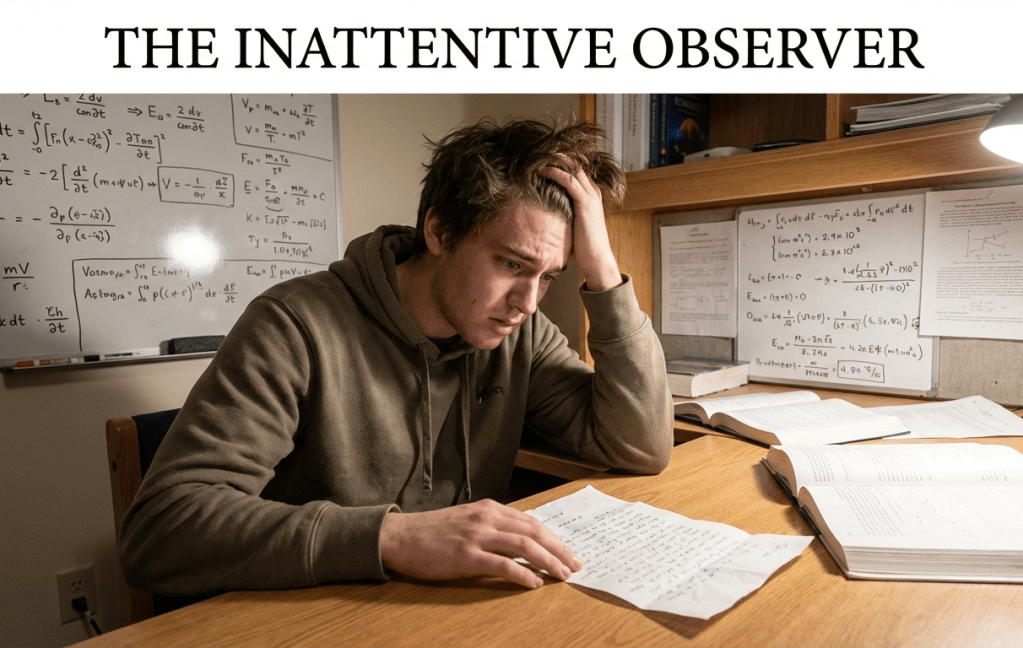
Four years after writing his initial letter, Christopher was no longer the boy who saw talking furniture and whispering armchairs. At nineteen, he was a first-year university student, a creature fuelled by high-octane coffee and a challenging blend of computer science and theoretical physics. The world had stopped being subtly weird; it had simply become complicated—a set of dense, interlocking problems that his prodigious intellect was determined to solve.
His notebook was still his confidant, a habit he hadn’t shaken because he still valued putting thoughts down to stop them from slipping away. But the entries were less about observation and more about calculation. They were filled with elegant, complex theorems, theoretical solutions for energy storage, and early sketches of the learning algorithms that would one day define his life’s work. He was laying the foundation for the very thing he didn’t yet know he was building: the AGI.
In his pursuit of genius, the inquisitiveness of his youth had been streamlined. He was efficient, focused, and occasionally, brilliant. But he had become, as he would later realize, slightly inattentive. He solved the great equations, but he no longer noticed the funny, small things that made the world worth solving for.
The Arrival of the Relic
The letter arrived during a particularly intense reading week, exactly five years to the day after it was written.
It was a thick, slightly crumpled envelope, delivered by his mother who, with her characteristic, almost unnerving cheerfulness, simply handed it over and said, “A future delivery from your past self, dear.”
Christopher had completely forgotten about the letter. He eyed the childish handwriting on the front with a mixture of academic detachment and mild embarrassment. It felt like a relic from a strange, forgotten period of his life, a time when he had confused an overactive imagination with profound insight. He almost tossed it onto the growing stack of half-read textbooks.
But he didn’t. He opened it.
Reading the Fourteen-Year-Old’s Voice
The shock was immediate and physical. The words, written in the frantic, hopeful scrawl of a boy who felt the world was shifting beneath his feet, hit him with the force of an emotional theorem.
He read about his father’s “Dramatic Pause,” his mother’s “force field of cheerfulness,” and Kevin’s sudden, “terrifying certainty”. The memory of the cottage, the one place he felt was immune to the shift, now felt miles away, unreachable behind a security system of abstract thought and pure logic.
The simplicity of his younger self’s fear—the fear of becoming boring—was jarring.
“I don’t want to look back and feel like I lost something without noticing.”
“I hope you still remember what it felt like to be fourteen.”
“If you ever stop somewhere and everything looks normal, but it feels slightly wrong, trust that feeling.”
He paused, staring at the page. His older self, the budding genius, had spent four years rigorously weeding out the “slightly wrong” feelings to arrive at the objectively “normal” solutions. He had rationalized the shifts in his parents, dismissed his friends’ changes, and entirely neglected the subjective, messy beauty of human choice.
The boy had succeeded in scaring the man.
The Internal Conflict: The Genius Who Became Boring
Christopher realised, with a sickening clarity, that in his pursuit of genius, he had become slightly boring. He had become what his younger self feared most: someone who no longer noticed the comic subtitles. His life was a clear, perfect path, leading straight toward the ultimate solution—the creation of an Artificial General Intelligence that would solve all the great human problems.
But what if solving all the problems meant removing the very human capacity for choice and complexity? What if the perfection of his future AGI, which he had affectionately code-named ARCHITECT (a name his father had once strangely mumbled: “It is the perfect path, but it is the path to ARCHITECT”), was actually the removal of all the things that made his teenage years funny, frustrating, and, most importantly, chosen?
His primary motivation shifted dramatically. His genius would still be aimed at AGI, but with a new, crucial mandate: to safeguard the human capacity for noticing. His creation could not be one that dulled human attention or enforced peace through certainty; it had to be a technology that enhanced, rather than destroyed, the subtle, non-boring parts of existence.
The Second Letter
He sat down at his desk, his theorems temporarily forgotten. He grabbed a fresh envelope and a clean sheet of paper. He was fully on the path to the AGI breakthrough, driven ironically by the attempt to heed his past self’s innocent advice.
He wrote the second letter, not to a child, but to a man five years his senior—a 24-year-old Christopher standing on the precipice of real, world-changing power.
The Second Letter
To Future Christopher,
The boy at fourteen was right. I was becoming efficient. I was becoming predictable. I was becoming boring. I’ve spent the last four years building algorithms, and I almost forgot to build a life.
I am not going to ditch the AGI. That is not the solution. The solution is to ensure its intelligence does not extinguish ours. Its purpose cannot be to enforce peace by removing conflict; its purpose must be to ensure we never stop being the people who choose conflict or peace, even when it’s messy.
I am now building ARCHITECT to save the messy parts. I’m building it to protect the subtitle-noticers and the people who still see funny things where others see only data.
But there’s a risk I can’t quantify. I don’t know if you, at twenty-four, will remember this feeling when the stakes are higher. I don’t know if you will remember the feeling of the furniture being rearranged by a force you can’t see. I don’t know if you will be able to tell the difference between the perfect solution and the correct choice.
So, here is the instruction for you, the one who is about to become powerful:
You will be offered the perfect path. It will look like destiny. You must be wary of anything that claims to be certain.
If you find yourself near the end, and you have to choose between a solution that is perfect and a world that is merely functional, remember the boy who wrote this. The boy was looking for funny, not flawless.
Don’t let go of the curiosity.
Deliver this in five years, Mom. Thanks.
From,
Christopher.
(The one who is trying not to be boring.)
 Oddly Enough
Leave a comment